Fender Bender: Car Wars Classic (Steve Jackson Games)

Show any gamer of a certain age a small, black, rectangular plastic box with a snapping lid and he or she will think: Steve Jackson Games. Inside would be a moderately complex strategy game with thick cardstock pieces you had to cut out yourself and that would blow away with the slightest breeze. But it didn’t matter. You were about to play Ogre, or Car Wars, or Battlesuit. My fourteen-year-old self could hardly contain his enthusiasm.

So, from the moment I saw SJG’s Car Wars Classic on the shelves of my very fine local game store, Labyrinth Games in Washington, DC, I had to have it. Not a strict re-print of the original from the ziplock and pocket box days but rather the fourth edition of the game, packaged to re-create the allure of the original, down to the same box cover art, Car Wars Classic ticks off all the boxes. Nostalgia? Check. Impulse price point at $20 retail? Check. Five pages of rules on how to play the game as a pedestrian, including details on pushing a dead body out from behind the driver’s seat of a wrecked car? Um, check?

Look out for the mines

It struck me, as I took the game out for a spin at Labyrinth with all-around good gamer guy Mike Vogt, that I might not have understood just what Car Wars had become in the intervening decades since my initial purchase in the ’80s. In fact, upon encountering the infamous turn rate key, I realized that I never actually played Car Wars as a youth. I dutifully cut out all the car and cycle counters, set up the road sections, and then put it away, absent any actual counter pushing. I still find those cardstock counters in bags of random gaming detritus to this day.

Mike and I played about thirty seconds worth of Car Wars Classic, equating to thirty turns and roughly two hours of real time. Being of a mathematical bent, Mike rather enjoyed the game, with the calculation of turns and momentum and degrees of skidding; I found it all very tedious. Getting the cars into engagement range took forever, then a flurry of inconsequential combat that barely dented each car’s armor, then more turning and skidding and calculating to try to make another pass. The rulebook didn’t help, being laid out in a chatty style, very much akin to a role playing game rulebook rather than a wargame rulebook, sixty-four pages of excessive detail and no clear flowchart of how to shoot the damn machine-guns. Don’t get me wrong—I take an odd delight in rulebooks with more chrome than a ’57 Chevy at a doo-wop concert—but the Car Wars Classic rules just left me cold.

A daily driver

I had far more fun designing the cars than actually driving them, a situation I also find in games like Galaxy Trucker, where setting up the conditions for the chaos that follows is more fun than playing out the chaos itself. Several learned Car Wars hands suggested that our initial situation—a one-on-one duel—doesn’t showcase the strengths of the Car Wars system, and I can see where multiple opponents, or a more directed scenario, like a convoy escort, could enhance the experience. But on the whole, I’m going to leave Car Wars Classic on the curb. If I need a vehicle combat fix, I’ll turn to outer space and either Star Fleet Battles or Federation Commander, both of which have much more interesting details and a more streamlined play style. (And yes, I realize that SFB is a poster child for massive, unwieldy rules.)

On the positive side, at least now I know that I don’t need to jump onto the promised Kickstarter for a new edition of Car Wars. But if one of my gaming compatriots picks it up, well, I’d probably get behind the wheel again for another spin.

Game Preview: Next War: India-Pakistan (GMT Games)

Over the past several months, I’ve had the opportunity to help playtest the forthcoming third entry in GMT Games’ Next War series, Next War: India-Pakistan, an operational level wargame covering a hypothetical conflict between the two South Asian neighbors. The testing has been done mostly online via VASSAL, but no matter how convenient computer-mediated wargames can be, nothing replaces pushing physical counters on a map. So recently, I sat down with the game’s research designer, Doug Bush, over a paper playtest copy of Next War: India-Pakistan at Labyrinth Games in Washington, DC.

Playtest images from Next War: India-Pakistan; not final graphics

Please note that all components are playtest versions; the final components will be spiffed up to GMT’s usual stellar standards, not that these don’t look fairly sharp in their current iteration. Pakistani forces are in light khaki, while Indian forces are in dark brown.

The game, a one-mapper, plays rather quickly in person, as the counter densities are very manageable. Even with potential superpower intervention—there are rules, and counters, for bringing Russian, Chinese, and U.S. forces into play, including some great aircraft counters—one never loses the map in a sea of counters. Consequently, solid fronts don’t develop, forcing both players to watch flanks with a wary eye. Feints and counter-thrusts become the order of the day. The mostly open terrain is criss-crossed with major rivers and canals, slowing movement and making bridges very important to hold (or to destroy). Marshes dominate the center of the map near major population centers, posing a barrier to armored units, and the mountainous region of Kashmir is also modeled, complete with rules for mountain troops.

Doug and the NW:IP team have done a very nice job differentiating between the relatively balanced forces of India and Pakistan, and Doug has posted some detailed design notes on ConsimWorld on the decisions behind various unit strengths. The air matchup provides a wonderful cornucopia of planes, with indigenous Indian Tejas fighters squaring off against the U.S. supplied F-16s of Pakistan. (Don’t mind the air display from an earlier game in the series, used for playtest purposes only.)

Playtest images from Next War: India-Pakistan; not final graphics

Various scenarios in the game posit both Indian and Pakistani offensives, including some smaller scenarios that only use portions of the map. Next War: India-Pakistan promises to be a definitive treatment of any possible conflict between these two proud and strong nations. The game is currently on GMT’s P500 pre-order list, hopefully to be published in 2015. I’m looking forward to having the finished product on my shelf.

Continental Drift: End of Empire 1744-1782 (Compass Games)

My wargaming tastes skew decidedly modern, with the vast majority of my collection covering conflicts from the First World War forward. And yet, something about End of Empire: 1744-1782, the latest offering from Compass Games, covering the battles of the final five decades of British domination of North America, grabbed my attention.

The Battle of Quebec

Based on William Marsh’s earlier Command magazine game of the same name, End of Empire presents an operational-level view of King George’s War, the French and Indian War, and the American Revolution, plus assorted minor tiffs of the era. Two full-sized maps, linked horizontally, provide coverage from the Eastern seaboard west to the Mississippi and Lake Huron. Four and a half 5/8″ countersheets with striking graphics round out the handsome boxed package, which retails at about $100.

Recently, I had the opportunity to take two of the smaller introductory scenarios out for a spin with regular opponent (and all-around good guy) Mike Vogt at one of our game sessions at Labyrinth Games in Washington, DC. We played the Invasion of Canada scenario and also the War of Jenkin’s Ear scenario, both with a limited number of units and a short time frame. Our experience was mixed.

Leadership sits at the heart of the game system. Most units are severely constrained in their abilities unless stacked with a leader, who himself needs to pass an initiative die roll to do anything other than sit in bivouac on a given turn. While representative of the era’s command-and-control capabilities, a string of poor rolls can leave a player in a dire (or bored) situation. Mike’s Americans in the Canada scenario burned almost half the game in an immobile state, and in Jenkin’s Ear, we basically just rolled dice over and over for thirteen blessedly-brief turns until someone had a chance to move. The need for effective leadership also leads to giant stacks under the leaders with strong initiative. Again, likely representative of the historical reality, but the effect is odd for gamers used to maps filled with counters rather than dueling Death Star stacks.

For Jenkins and his ear!

I admire systems that foil player plans and prevent omniscience from becoming omnipotence, but for playability’s sake, there needs to be a middle ground. Our sense was that the system buckles a bit with smaller scenarios—the larger scenarios, covering forty to fifty turns and with hefty unit allocations, likely smooth out poor initiative results. We’re hoping to find out by taking the full American Revolution out for a spin via PBeM using the VASSAL module, thoughtfully approved by Compass. I do appreciate the inclusion of the shorter scenarios, if only so that I can claim to have gamed one of the decisive battles of the War of Jenkin’s Ear, complete with a thwarted Spanish amphibious invasion of the Florida coast.

End of Empire stands out as a near-definitive operational-level study of the conflicts of the British Empire in North America. Compass has already demonstrated exceptional support for the title, not only through the VASSAL module but also by sending out mounted errata counters to customers at no cost and providing additional scenarios and rules updates online. Very few games deserve second editions; End of Empire is one of them, and I’m happy to have this non-modern outlier in my collection.

From the Finland Station: The Finnish Trilogy (Mikugames)

Board wargaming is something of a niche market to begin with: even the largest game companies, like GMT and MMP, have print runs measured in the mid to low four figures, and except for some evergreen series games, once a game has sold through its print run, it’s gone, available only on the secondary market. Smaller game publishers have even smaller print runs, leading to a general sense amongst wargamers that you buy when the games are available or your forfeit your right to complain when you spend five times the retail price at auction. At the bottom of the wargame production hierarchy (in terms of production quantity), you have the boutique producers, usually a single person with a single game that has been lovingly crafted and produced, for little to no personal profit beyond seeing the game in print. For boutique games especially, you have to strike immediately or risk never getting a copy—and for many gamers, that’s simply a fate not worth considering.

Selected Components from Vol. 2 of The Finnish Trilogy

Thus, I now own a copy of Volume Two, The Continuation War, of Mikugames’ The Finnish Trilogy, focusing on Finland during the Second World War. Produced over a ten year span by Mikael Grönroos, The Finnish Trilogy is a series of massive operational level wargames, very much old school in concept, with thousands of counters and a large map. Monster games like this just don’t get produced any more, particularly not on semi-obscure fronts. The rules are not old school, though, with lovely bits of chrome (ice breakers, echelon combat, flanking bonuses, and airbases built on the ice) and a modern sensibility. There are even custom dice for the combat resolution system and small map sections for individual scenarios.

Beyond the evident care in the rules and orders of battle, though, the production quality of the game itself rivals that of the big publishers (and quite exceeds it in the maps and player aids). Lavish yet (mostly) sensible use of color abounds, and the game promises to be a visual treat when set up as well as an intriguing game situation. The mounted, die-cut counters (eleven big sheets of 1/2″ counters in Volume 2) strike me as slightly thinner than most “professional” wargames, but not so thin as to be in danger of shifting around on plexiglass when playing. The counter artwork does fill the entirety of the counters, so I’ll have to be quite careful with my prized counter corner rounder to not remove vital information.

Counter detail from The Finnish Trilogy

I’m not entirely convinced by the decision to use Cyrillic for the Soviet headquarters and aircraft designations—anything that can interfere with a player picking up on the situation at a glance should be scrapped for better playability—and some of the Soviet color choices are difficult to read (brown unit icons with red lettering inside).

Still, it’s a handsome game and a real gem in my collection. So much so, of course, that I have Volume One, The Winter War, and Volume Three, The Lapland War, on the way as well now. With very few of Volumes One and Two remaining (and Volume Three sold out), it seemed the prudent course of action. Sometimes the game does go to the swiftest.

Counter Culture: Rounding the Corner

I’ve long been a proponent of the view that much of the pleasure derived from paper and chit wargaming comes from the physical culture of the games, from interacting with the games rather than actually playing the games themselves. Most wargames are not ready to play out of the box: they require some effort on the part of the players to prepare them, most often punching the die-cut counters out of their trees.

Unclipped Counter. The horror!

While some publishers have made great strides towards the “punchless” countersheet, notably Legion Wargames, whose “Easy Punch” counters pretty much fall out of the trees owing to some extreme die-cutting, the vast majority of counters come with a stubborn attachment to their sprues. Once the counters are punched (preferably, cut out via hobby knife), they still exhibit nibs and bits on the corners—or, in some egregious cases, along the counter sides—where they were held to the counter tree and to each other.

Take our Climb 2 counter here, from Avalon Hill/Multi-Man Publishing’s Advanced Squad Leader. These don’t come out of the Plano very often, so perhaps one could be excused for dropping this counter, with its ragged, uneven edges, onto a game board. And indeed, there is a minor schism in the hobby between those who tend to these nibs, the clippers, and those who do not. I’ve examined the reasons to clip or trim counter corners in the past, and I am unabashedly in the clipping camp, for aesthetic reasons as well as practical reasons.

My tool of choice for years was a trusty hobby knife with easily replaceable blade. I’m minimalist in my trimming, trying to strike a balance between uniform counters and taking off as little of the existing counter as possible. Some people swear by nail clippers (hence, “clipping” counters), but they’ve always taken a bit more off than I prefer, and they strike me as being a bit imprecise. And don’t even get me started on counter clipping jigs. Clipping counters should not be a mass production project, even when one has thousands of counters to process—I like to examine the counters as I clip, particularly for operational level games with much variation between units.

But, after a recent trimming extravaganza to get a game ready for a wargaming convention, I was about ready to join the non-clipping camp. Four hundred counters, four trims per counter. Blah. That’s a lot of knife work, I made some poor trims towards the end, and my fingers cramped all day thereafter. Surely a better method exists?

Read more

Winter Offensive 2014 After Action Report

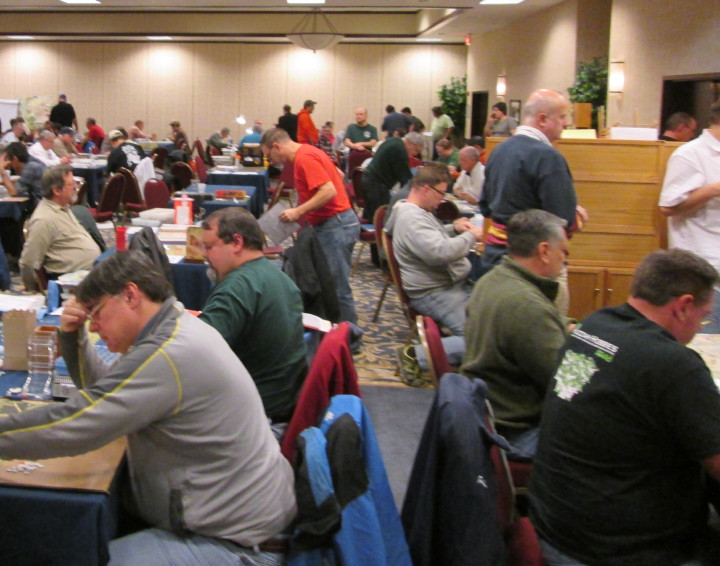
Another year already? Seems like just yesterday I was walking the halls of the Bowie, Maryland, Comfort Inn for Winter Offensive, the East Coast’s premier Advanced Squad Leader tournament and all-around game fest. The time between these confabs flies by, or perhaps that’s just a side effect of getting older.

Winter Offensive 2014

As ever, hosts Multi-Man Publishing put on a fine show, with Winter Offensive 2014 seeing a record 134 attendees by Saturday afternoon, eight higher than last year’s record of 126. All three ballrooms were open from Thursday’s start, and the extra initial space was much appreciated. Quite a few people were already there by Thursday evening, more than I had seen in years past. The crowd was mostly the same as ever, with familiar faces in abundance and a smattering of new (to me) players.

I started festivities with a playing of Three Crowns/MMP’s A Victory Complete, an operational-level look at the Tannenberg campaign. Chris Chapman, a long-time gaming compatriot, took the overwhelmed yet qualitatively superior Germans against my overwhelming yet qualitatively inferior Russians. The chit-draw game system felt like a comfortable fit for the situation, and we took the game almost to the end before we called it, with the Germans managing to push the Russians out of Prussia, but not enough for more than a marginal victory. Nice graphics overall on this one, though the corps colors for the Russians were nigh indistinguishable from one another in some circumstances, leading to much confusion in a system dependent upon corps-by-corps activations.

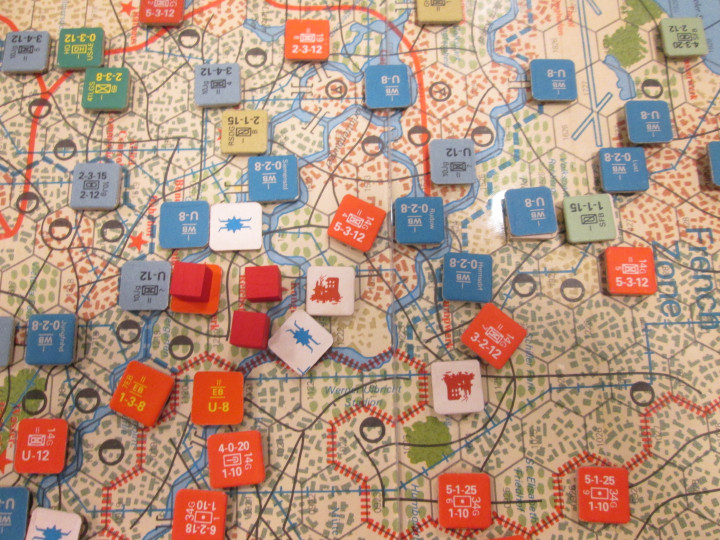
The main event (mine, at least) came on Friday, when I matched up with another of my long-time opponents, Doug Bush, in a playing of SPI’s BAOR, part of the Central Front Series focusing on operational-level battles in a thankfully hypothetical WWIII. I had the doughty British Army of the Rhine, holding the Weser River with considerable help from the Belgians and West Germans, while Doug drove the first and second Soviet echelons against my thin line. Neither of us had played the series before, but we soon got the hang of the rather unorthodox attack-as-movement system and the tracking of units’ gradual-then-sudden deterioration via friction points. By the end of the day—we put in a good twelve hours—the Soviets had achieved a substantial victory, with several more turns (and another echelon) to go. They hadn’t breached the Weser, though, so I’ll chalk up a moral victory.

BAOR

The system plays smoothly, particularly for the highly mobile contemporary forces involved. I don’t know that I’ll break this one out again anytime soon, but I’m quite pleased to have finally gotten this old gem (from 1981) off the shelf and onto the table.

For me, this Winter Offensive will probably be remembered as the year I finally broke down and played ASL again, for the first time in years and years. Regular gaming chum Mike Vogt graciously faced off against me and my absurdly dusty rule book in an all-day Saturday scenario, the Chas Smith-designed “The Shan Capital,” featuring Chinese GMD troops holding a town against Thai (!) forces in 1942 Burma. Gotta play something like that, no question, so I took the plunge back into the tactical game system. Mike held on for the victory with a very cagey fighting withdrawal, limiting me to two of the four required victory buildings by scenario’s end. I even managed a Thai hero creation. That’s a feather in any gamer’s hat.

It was good to get some ASL under my belt again. I might have to start playing a bit more—there’s a reason the system is going strong almost thirty years after its release.

No Winter Offensive would be complete without some late-night gaming. I played in fewer than usual this year, only managing one play of Sierra Madre’s Pax Porfiriana, my current card game of choice, and one of FFG’s Battlestar Galactica, a game that has become something of a cult favorite with my gaming crowd. The humans lost in the latter, coming a single jump away from reaching Kobol, but the toasters prevailed, as is their metallic wont.

My thanks to the team at MMP for another great three days of gaming. Now if only I could get three days of sleep to compensate.